Clip Art Group Protesting New Jersey State Clip Art
American Anti-Slavery and Civil Rights Timeline
Timeline compiled past V. Chapman Smith
- 1472
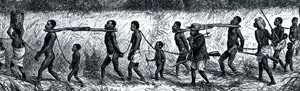
- Portuguese negotiate the starting time slave trade agreement that also includes gold and ivory. Past the end of the 19th Century, because of the slave trade, v times as many Africans (over eleven million) would arrive in the Americas than Europeans.
- 1503
- Castilian and Portuguese bring African slaves to the Caribbean and Primal America to replace Native Americans in the gold mines.
- 1610
- Henry Hudson's ship, the Half Moon arrives in the "New Earth" mostly likely carrying African slaves. The Dutch were deeply involved in the African slave trade and brought the trade to the American colonies. The Dutch built and grew wealthy on an Atlantic empire of sugar, slaves, and ships.
- 1619
- A Dutch transport brings the first permanent African settlers to Jamestown, VA.
- 1641
- Massachusetts becomes the first colony to recognize slavery equally a legal establishment in 1641 Body of Liberties.
- 1651
- Rhode Island declares an enslaved person must be freed after 10 years of service.
- 1663
- A Virginia courtroom decides a child born to an enslaved mother is too a slave.
- 1671
- George Play a joke on, generally chosen the founder of the Religious Club of Friends (Quakers), influences agitation amongst Quakers against slaveholding past Society members when he speaks confronting slavery on his visit to Northward America.
- 1672
- The King of England charters the Imperial African Company, thereby encouraging the expansion of the British slave merchandise.
- 1676
- Nathaniel Bacon (Bacon's Rebellion) appeals to enslaved blacks to join in his cause.
- Slavery is prohibited in Westward New Bailiwick of jersey, a Quaker settlement in current day South New Jersey.
- 1688
- In Germantown (at present Philadelphia, PA.), Quakers and Mennonites protest against slavery. During this period, these groups worshiped together.
- 1693
- An Exhortation & Caution to Friends Apropos the Buying or Keeping of Negroes by the Philadelphia Monthly Meeting is published in Philadelphia.
- 1730
- From this time onward, England trades aggressively in North American slaves, with New York, Boston and Charleston thriving as homeports for slave vessels.
- 1750
- Georgia is the last of the British North American colonies to legalize slavery.
- 1754
- John Woolman (b. New Jersey 1720; d. York, England 1772) addresses his fellow Quakers in Some Consideration of the Keeping of Negroes and exerts great influence in leading the Society of Friends to recognize the evil of slavery. Philadelphia Yearly Coming together appoints a committee in 1758 to visit those Friends nevertheless holding slaves. At the Yearly Meeting in London in 1772, Woolman presents an anti-slavery document from Philadelphia. The London Yearly Meeting likewise issues a statement condemning slavery in its Epistle for the commencement time in 1754.
- 1759
- Publication in Germantown (PA) of Anthony Benezet's pamphlet, Observations on the Inslaving [sic], Importing and Purchasing of Negroes, the kickoff of many anti-slavery works by the virtually influential antislavery writer of 18th century America.
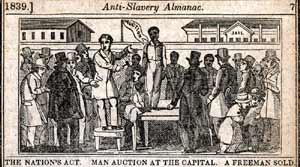
Library Company of Philadelphia
- 1775
- Founding of the Pennsylvania Society for Promoting the Abolitionism of Slavery (PAS), the earth'south first antislavery society and the first Quaker anti-slavery club. Benjamin Franklin becomes Honorary President of the Society in 1787.
- Thomas Paine speaks out against slavery and joins the PAS with Benjamin Rush.
- 1780
- Gradual Emancipation Act passed in Pennsylvania.
- 1785
- Publication in London of John Marrant's book, A Narrative of the Lord's Wonderful Dealings with John Marrant, a Black Man, the get-go autobiography of a gratis black.
- 1786
- Publication in London of An Essay on the Slavery and Commerce of the Man Species, Specially the African, by Thomas Clarkson. Quickly reprinted in the The states, it is the single most influential antislavery work of the belatedly 18th century.
- 1787
- Northwest Ordinance bans slavery in the newly organized territory ceded past Virginia.
- Founding in London of the Order for Effecting the Abolition of the Slave Merchandise.
- Philadelphia costless blacks establish the Gratuitous African Society in Philadelphia, the first independent black organisation and a mutual help society.
- The ratified U.S. Constitution allows a male slave to count as three-fifths of a human in determining representation in the House of Representatives. The Constitution sets 1808 as the earliest date for the national government to ban the slave trade.
- Rhode Isle outlaws the slave trade.
- William Wilberforce becomes the Parliamentary leader and begins a ten-year entrada to abolish U.k.'s slave trade.
- 1788
- Pennsylvania apology law to forbid removal of blacks from the state.
- 1791
- First American edition of The Interesting Narrative of the Life of Olaudah Equiano, an centre-witness account of the Centre Passage and the first autobiography by an enslaved African, is published in London in 1789.
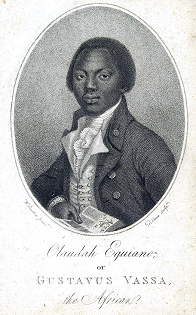
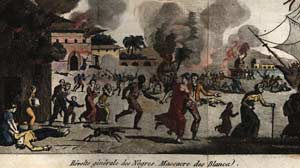
- Slave insurrection in the French colony of St. Domingue begins the bloody process of founding the nation of Haiti, the first contained black country in the Americas. Refugees flee to America, many coming to Philadelphia, the largest and most cosmopolitan city in America with the largest northern free black community. Philadelphia has many supporters for Toussaint L'Overture.
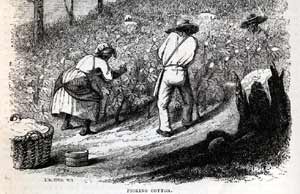
- Eli Whitney patents the cotton gin, making it possible for the expansion of slavery in the Due south.
- 1793
- U.S. Congress enacts first fugitive slave law requiring the return of fugitives.
- Hoping to build sympathy for their citizenship rights, Philadelphia gratis blacks rally to minister to the ill and maintain gild during the yellow fever epidemic. Many blacks fall victim to the disease.
- 1794
- Founding of the American Convention for Promoting the Abolition of Slavery, a joining several country and regional antislavery societies into a national organization to promote abolition. Conference held in Philadelphia.
- The first independent blackness churches in America (St. Thomas African Episcopal Church and Bethel Church) established in Philadelphia by Absalom Jones and Richard Allen, respectively, every bit an human action of cocky-determination and a protest confronting segregation.
- Congress enacts the federal Slave Trade Human activity of 1794 prohibiting American vessels to transport slaves to any strange land from outfitting in American ports.
- 1797
- In the beginning black initiated petition to Congress, Philadelphia free blacks protestation North Carolina laws re-enslaving blacks freed during the Revolution.
- 1799
- A Frenchman residing in Philadelphia is brought before the Mayor, Chief Justice of Federal Court and the Secretary of State for acquiring 130 French uniforms to send to Toussaint L'Overture.
- 1800
- Absalom Jones and other Philadelphia blacks petition Congress against the slave merchandise and against the fugitive slave human action of 1793.
- Gabriel, an enslaved Virginia black, attempts to organize a massive slave insurrection.
- Off the coast of Cuba, the U.S. naval vessel Ganges captures two American vessels, conveying 134 enslaved Africans, for violating the 1794 Slave Trade Human activity and brings them to Philadelphia for adjudication in federal court by Judge Richard Peters. Peters turns the custody of the Africans over to the Pennsylvania Abolition Society, which attempts to digest the Africans into Pennsylvania using the indenture system with many local Quakers serving equally sponsors.
- 1803
- Benjamin Rush elected president of the Pennsylvania Abolition Society
- 1804
- Final defeat of the French in St. Domingue results in the founding of Haiti as an independent black nation, and an inspiration to blacks in America. Haitian Independence Twenty-four hours is celebrated throughout northern free blackness communities.
- 1807
- Parliament outlaws British participation in the African Slave Trade.
- 1808
- United States outlaws American participation in the African Slave Merchandise. Jan 1st becomes an instant black American vacation, commemorated with sermons and celebrations. These sermons are the first distinctive and sizable genre of blackness writing in America.
- 1813
- Philadelphia black businessman and community leader James Forten publishes his pamphlet, A Series of Letters past a Man of Color, to protestation a proposed police requiring the registration of blacks coming into the land.
- 1816
- American Colonization Society is formed to encourage free blacks to settle in Republic of liberia, West Africa.
- Several new contained black denominations are established within the African Methodist Episcopal Church under commencement bishop Richard Allen.
- 1819
- Federal law passed requiring the inspection of rider conditions on ships is used past Quakers to monitor weather in the slave merchandise at the Baltimore (Maryland) Port. Society of Friends members accompany federal Community inspectors.
- 1820
- Missouri Compromise allows Missouri to become a slave state, establishes Maine equally a free state, and bans slavery in the territory west of Missouri.
- The kickoff organized emigration of U.S. blacks dorsum to Africa from New York to Sierra Leone.
- 1821
- New Jersey Quaker born Benjamin Lundy establishes the get-go American anti-slavery newspaper, The Genius of Universal Emancipation, in Mt. Pleasant, Ohio. From September 1829 until March 1830, William Lloyd Garrison assists the paper. In 1836-1838 Lundy establishes and some other anti-slavery weekly in Philadelphia, The National Enquirer. This newspaper becomes The Pennsylvania Freeman with John Greenleaf Whittier every bit one of its later editors.
- 1822
- Denmark Vesey, a gratuitous black, organizes an unsuccessful slave insurgence in Charleston, SC.
- Segregated public schools for blacks open in Philadelphia.
- 1824
- Republic of liberia, on the west coast of Africa, is established by freed American slaves.
- 1827
- John Russwurm and Samuel Cornish establish the first African American newspaper, Freedom's Periodical, in New York. The paper circulates in eleven states, the District of Columbia, Haiti, Europe, and Canada.
- Sarah Mapps Douglass, a blackness educator and correspondent to The Anglo African, an early on black paper, establishes a school for black children in Philadelphia. Mapps becomes an important leader in the Female person Anti-Slavery Club and is a life-long friend of Angelina and Sarah Grimke. Subsequently the Civil War, she becomes a leader in the Pennsylvania Co-operative of the American Freedman's Aid Commission, which worked to protect and provide services to the former enslaved in the Due south.
- 1829
- David Walker of Boston publishes his peppery denunciation of slavery and racism, Walker'due south Appeal in Four Articles. Walker's Entreatment, arguably the almost radical of all anti-slavery documents, causes a great stir with its telephone call for slaves to defection against their masters and its protest against colonization.
- 1830
- Virginia legislature launches an intense debate on abolishing slavery.
- In response to Ohio's "Black Laws" restricting African American freedom, blacks migrate due north to establish free black colonies in Canada, which becomes an important refuge for fugitive slaves.
- The kickoff National Negro Convention convenes in Philadelphia.
- 1831
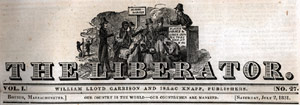
- William Lloyd Garrison of Boston begins publishing The Liberator, the virtually famous anti-slavery newspaper.
- Nat Turner launches a encarmine uprising among enslaved Virginians in Southampton Canton.
- 1832
- Maria Stewart of Boston launches a public career every bit a speaker and pamphleteer. Stewart is i of the showtime black American female political activists to establish the tradition of political activism and freedom struggle among black women. She calls upon blackness women to take upward what would go pioneering piece of work as teachers, school founders, and pedagogy innovators.
- 1833
- American Antislavery Social club, led by William Lloyd Garrison, is organized in Philadelphia. For the next three decades, the Society campaigns that slavery is illegal under natural constabulary, and sees the Constitution "a covenant with hell." Within five years, the organization has more than than 1,350 chapters and over 250,000 members.
- 1834
- August 1 becomes some other black American and abolitionist holiday when Britain abolishes slavery in its colonies.
- 1835
- Female antislavery societies are organized in Boston and Philadelphia. The Philadelphia Female Anti-Slavery Society was an integrated grouping of white and black middle class women, led by Lucretia Mott, Harriett Forten Purvis, and Grace Bustill Douglass. The women met in each other'due south homes. Bustill, Mapps, and Douglass are prominent black Quaker families in the Philadelphia in the 19th Century.
- Abolitionists launch a campaign flooding Congress with antislavery petitions.
- 1836
- The public careers of Angelina and Sarah Grimke, Quaker abolitionists from a prominent Due south Carolina family, begin.
- 1837
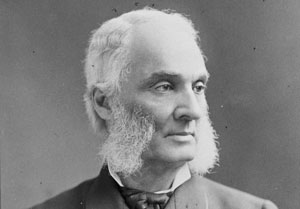
- Philadelphia blacks, under the leadership of well-to-exercise Robert Purvis, organize the Vigilance Committee to aid and help fugitive slaves. Purvis' married woman, Harriett Forten Purvis, the daughter of successful black businessman James Forten, leads the Female Vigilant Society. By his contemporaries, Robert Purvis is referred to as the "President of the Underground Railroad."
- First gathering of the Antislavery Convention of American Women, an inter-racial association of diverse female person antislavery groups, becomes the start independent women's political system.
- Founding of the Found for Colored Youth, which later became Cheyney University, one of the earliest historically black colleges in the United States.
- 1838
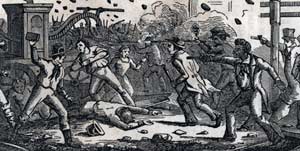
- Philadelphia is plagued with anti-blackness and anti-abolitionist violence, particularly from Philadelphia white workers who feared that they have to compete with freed slaves for jobs. Second meeting of the Antislavery Convention of American Women, gathered in Philadelphia at the newly congenital Pennsylvania Hall, is attacked by a mob. The mob burns down the hall, as well every bit sets a shelter for black orphans on fire and damages a black church. Pennsylvania Hall was open up only 3 days when information technology barbarous. More than than 2,000 people bought "shares" and raised $twoscore,000 to build the Hall. An official report blames abolitionists for the riots, claiming that they incited violence by upsetting the citizens of Philadelphia with their views and for encouraging "race mixing."
- Pennsylvania blacks are disfranchised in the revised state Constitution.
- A Maryland slave named Fred runs away and later becomes Frederick Douglass.
- 1839
- Abolitionists form the Liberty Political party to promote political activeness against slavery.
- Pope Gregory 16 condemned slavery and the slave trade.
- 1840
- American Anti-Slavery Society splits over the issue of the public involvement of women. Dissidents opposed to women having a formal function form the American and Strange Anti-Slavery Society.
- Anile and venerable abolitionist Thomas Clarkson chairs the Earth Anti-Slavery Convention in London. American attendees include William Lloyd Garrison, Lucretia Mott, and Elizabeth Cady Stanton. American women are not immune to sit among the men or serve equally delegates. On their return to America the women hold a women's rights convention, which met in Seneca Falls, NY in 1848.
- Martin Delany publishes The Mystery, the first Blackness-owned newspaper w of the Alleghenies and he later serves as co-editor of the Rochester North Star with Frederick Douglass.
- 1842
- An angry mob of whites in Philadelphia attacks a black temperance parade celebrating Westward Indian Emancipation Day. A riot ensues with mayhem lasting three days and resulting in numerous injuries to blacks, who are dragged from their homes and beaten and several homes, an abolitionist coming together place, and a church building are set ablaze.
- 1845
- Narrative of the Life of Frederick Douglass, an American Slave is published in Boston, launching the public career of the nigh notable blackness American spokesman of the 19th Century.
- 1846
- State of war with Mexico adds significant western territory to the United states of america and opens a new arena in the fight to check the spread of slavery.
- 1848
- Free Soil Party is organized to end the spread of slavery into the Western territories.
- Slavery is abolished in all French territories.
- Women'southward Rights Convention is held at Seneca Falls.
- 1849
- Harriet Tubman escapes from slavery. She becomes a major conductor on the Underground Railroad, likewise as an advocate for Women's Rights.
- 1850
- The Compromise of 1850 includes a controversial Avoiding Slave Law that compels all citizens to help in the recovery of fugitive slaves. Free blacks grade more Vigilance Committees throughout the Northward to watch for slave hunters and alert the blackness community.
- 1851
- Federal marshals and Maryland slave hunters seek out suspected fugitive slaves in Christiana (Lancaster Canton), PA. In the ensuing struggle with black and white abolitionists, i of the attackers is killed, some other is seriously wounded, and the fugitives all successfully escape. Thirty-six black men and v white men are charged with treason and conspiracy under the federal 1850 Fugitive Slave Law and brought to trial in federal court at Independence Hall in Philadelphia. This trial becomes a cause celebre for American abolitionists. Attorney Thaddeus Stevens defends the accused by pleading self-defense. All the defendants are constitute innocent in a jury trial.
- 1852
- Congress repeals the Missouri Compromise, opening western territories to slavery and setting the phase for a bloody struggle between pro and anti slavery forces in Kansas Territory (Bleeding Kansas).
- 1854
- Lincoln Academy (Pennsylvania) is chartered in April 1854 every bit Ashmun Institute. It becomes a higher education institution providing an instruction in the arts and sciences for male youth of African descent. During the first one hundred years of its existence, Lincoln graduates approximately 20 percentage of the black physicians and more than than 10 percent of the black attorneys in the Usa. Thurgood Marshall and Langston Hughes are amid its esteemed alumni.
- Martin Delany leads 145 participants in the 4-twenty-four hour period National Emigration Convention in Cleveland, OH. His arguments appeal to some educated and successful northern freed blacks and are defiantly contrary the position held by Frederick Douglass and others. His views represent increasing frustrations in the blackness customs. Half-dozen years later, Delany signs a treaty with Nigeria to permit black American settlement and the development of cotton product using costless West African workers. However this project never develops. During the Ceremonious State of war, Delany works with others to recruit blacks for the 54th Massachusetts and other units. In 1865 Major Delany becomes the beginning black deputed equally a line field officer in the U.S. Ground forces.
- 1855
- With the assistance of others, William Still, a leader in the Philadelphia Underground Railroad, and his white colleague Passmore Williamson, intercept slave owner John Weaver, his slave Jane Johnson and her two sons as they are leaving boondocks. The two help Jane and her children go out their master for freedom. Williamson is incarcerated for several months for non bringing Jane Johnson to court. The case becomes a national news story, continuing from August through November.
- 1856
- The Republican Party, newly formed from various groups opposing the extension of slavery, holds its first convention in Philadelphia.
- Wilberforce University, named for English language statesman and abolitionist William Wilberforce, opens in Ohio as a private, coeducational institution affiliated with The African Methodist Episcopal Church. This is the first establishment of higher education endemic and operated by African Americans.
- 1857
- The Supreme Court'south Dred Scott decision declares blacks, free or slave, have no citizenship rights.
- 1859
- John Brown conducts a raid at Harper'south Ferry, Virginia to complimentary and arm slaves. His effort fails and he is executed.
- 1861
- Lincoln's ballot in 1860 leads to Southern states seceding and starts Civil War between the free and the slave states. The Secretarial assistant of the Navy authorizes enlistment of contrabands (slaves) taken in Confederate territories.
- 1862
- Showtime black Union Army forces are organized in South Carolina.
- Charlotte Forten, daughter of Robert Forten and Robert Purvis' niece, heads to Port Royal, South Carolina equally teacher for the Philadelphia Port Royal Commission for the "freed" slaves at present in Union controlled territory. The Atlantic Monthly publishes her essays on her experiences, "Life on the Sea Islands," in 1864.
- 1863
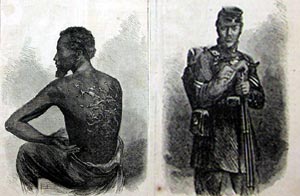
- Lincoln issues the Emancipation Annunciation abolishing slavery in territory controlled by the Amalgamated States of America. The Presidential Lodge also authorizes the mustering of black men as federal regiments.
- The 54th Massachusetts is organized at Campsite Meigs, Readville, Massachusetts. Gratuitous blacks from throughout the Northward enlist in the 54th. Other preparation stations, like Military camp William Penn, outside of Philadelphia in Cheltenham are established for grooming blackness troops. Between 178,000 and 200,000 blackness enlisted men and white officers serve under the Bureau of Colored Troops.
- 1864
- Congress rules that black soldiers must receive equal pay.
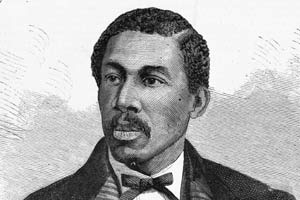
- The National Equal Rights League convenes in Syracuse, New York. Delegates are all prominent northern blacks, led by John Mercer Langston who after organized Howard University's Constabulary Section, and included Frederick Douglass and Octavius V. Catto. Working through state chapters, the League promotes an aggressive advocacy agenda to obtain civil rights for blacks. Pennsylvania, New York, Ohio, Illinois, Indiana and Michigan are charged to take the lead. Philadelphia blacks, led by Catto, boycott to desegregate public transportation.
- 1865
- The Civil War ends with a northern victory.
- With their freedom, Southern blacks seek to reunite their families torn apart by slavery, as well every bit acquire education (particularly reading and writing). Many exit the South for the West and North.
- President Lincoln speaks publicly about extending the franchise to black men, particularly "on the very intelligent, and on those who serve our cause as soldiers."
- Lincoln is assassinated by John Wilkes Booth.
- Andrew Johnson becomes President and begins to implement his own Reconstruction Program that does not crave the franchise for black men in the quondam Confederate states.
- Many northern states turn down referendums to grant blackness men in their states the franchise.
- Mississippi becomes the starting time of the old Confederate states to enact laws (Black Codes) severely limiting the rights and liberties of blacks. Other Southern states follow with similar legislation.
- Thirteenth Amendment to the Constitution abolishing slavery is ratified.
- The Freedmen's Agency is established in the State of war Department. The Bureau supervises all relief and educational activities relating to refugees and freedmen, including issuing rations, clothing and medicine. The Agency besides assumes custody of confiscated lands or belongings in the erstwhile Amalgamated States, border states, District of Columbia, and Indian Territory.
- The Ku Klux Klan is formed by ex-Confederates in Pulaski, Tennessee.
- 1866
- Republicans efforts begin to extend suffrage in the District of Columbia. Initial attempts neglect with President Johnson's vetoes. Suffrage is finally granted in 1867.
- Congress passes the kickoff civil rights act. President Johnson's veto of the bill is overturned past a two-thirds majority in both houses of Congress, and the bill becomes law. Johnson's mental attitude contributes to the growth of the Radical Republican motility. These Republicans favor increased intervention in the South and more help to erstwhile slaves, and ultimately to Johnson'south impeachment.
- Republicans proceeds veto-proof majorities in both the Senate and the House.
- In Nashville, Tennessee, Fisk University is established for quondam slaves by the American Missionary Clan. The school becomes the first black American college to receive a class "A" rating by the Southern Association of Colleges and Secondary Schools in 1878. Due west.Due east. B. DuBois graduates from Fisk in 1888.
- 1867
- The commencement election in the District of Columbia to include black voters results in a victory for the Republican ticket. Similar results are repeated in other areas of the country, where blacks are granted the franchise. These elections besides produce new black political leaders.
- Congress passes bills granting the franchise to black men in the territories of Nebraska and Colorado, over President Johnson's veto.
- Congress charters Howard University, named after General Oliver O. Howard, Commissioner of the Freeman Agency and the college's first president. The school's early on funding comes from the Freedmen'due south Bureau. From its offset, information technology was nonsectarian and open to people of both sexes and all races, although information technology is considered a historically black college. Howard becomes a premier education establishment in the black customs and plays an important role in civil rights history. Information technology is here that Thurgood Marshall earns his law caste.
- 1868
- Fourteenth Amendment is ratified making blacks citizens.
- White voters in Iowa pass a referendum granting the franchise to black voters.
- The Klu Klux Klan evolves into a hooded terrorist arrangement known to its members as "The Invisible Empire of the Due south." An early influential Klan "1000 Wizard" is Nathan Bedford Forrest, who was a Confederate full general during the Ceremonious War.
- 1869
- The National Convention of Colored Men meets in Washington, D.C., promoting suffrage for all black men and the education of quondam slaves. Advocacy and for rights continues through the Equal Rights Leagues. The franchise and other privileges are nevertheless denied black men in about northern areas.
- Congress approves an amendment to the Reconstruction beak for Mississippi, Texas, and Virginia, requiring those states to ratify the Fifteenth Amendment before being readmitted to Congress.
- New York becomes the kickoff northern country to ratify the Fifteenth Amendment.
- James Lewis, John Willis Menard, and Pinckney B.S. Pinchback, all blackness men from Louisiana, are elected to Congress and just are never seated.
- 1870
- The 15th Amendment is passed permitting black men the right to vote.
- Joseph H. Rainey of Due south Carolina is the first blackness to exist seated in the House. In all, 20-2 blacks are elected to Congress during Reconstruction .At that place were seven lawyers, three ministers, one banker, i publisher, two school teachers, and three college presidents.
- Hampton Normal Agricultural Institute is founded past Samuel Chapman Armstrong and chartered as one of the first colleges for blacks. It is also a pioneer in educating American Indians. Booker T. Washington is amidst its early graduates.
- Pennsylvania, the domicile of the oldest and largest northern complimentary black customs at the fourth dimension of the Civil State of war and a major heart for the abolition movement, grants the franchise to black men later thirty-two years of disfranchisement.
- 1871
- National Equal Rights League leader, Octavius V. Catto, is assassinated by a white human being attempting to discourage black voting in a key Philadelphia election. Catto'south funeral is the largest public funeral in Philadelphia since Lincoln'due south and his death is mourned in black communities throughout the state.
- 1875
- The final U.South. Congress of the 19th century with bi-racial Senate and House passes the Ceremonious Rights Deed of 1875. The police protects all Americans, regardless of race, in their access to public accommodations and facilities such as restaurants, theaters, trains and other public transportation, and grants the right to serve on juries. However, the law is not enforced, and the Supreme Court declares it unconstitutional in 1883.
- 1881
- Blanche K Bruce, Mississippi Republican, ends his term in the U.South. Senate. He is the last black to serve in the Senate until Edward Brooke, Massachusetts Republican, in 1967. With Reconstruction replaced with segregation, voting rights for blacks cease in many areas and greatly curtailed in others.
- Booker T. Washington begins to work at the Tuskegee Establish and builds it into a middle of learning and industrial and agricultural training for blacks.
- 1892
- Ida B. Wells Barnett begins her campaign confronting the lynching of blacks, a common practise by white racists and the Klan to instill fear in the blackness community. She later writes Southern Horrors: Lynch Constabulary in All Its Phases and becomes a tireless worker for women'southward suffrage.
- 1895
- W.E.B. DuBois begins his social analysis of the blackness conditions in Philadelphia. Published in 1899, The Philadelphia Negro becomes a lightening rod for black activism in Philadelphia and other communities effectually the land.
- 1896
- Supreme Court establishes 'split up but equal' doctrine with Plessy vs. Ferguson. This police force enables the expansion of growing segregation or "Jim Crow" practices across America, with many states codifying segregation in country constitutions and local laws and ordinances. By 1910, every state in the former Confederacy fully establishes a organization of legalized segregation and disfranchisement. The country largely embraces the notion of white supremacy, which re-enforce the cult of "whiteness" that predated the Civil War. Northern areas besides embrace "Jim Crow" practices, some codification in constabulary.
- 1901
- George Henry White (N Carolina Republican), the terminal black to serve in the Firm of Representatives in the 19th century, leaves role.
- 1905
- The Niagara Motion, the first meaning blackness organized protest movement of the twentieth century, is launched in Buffalo, NY. It is an endeavour by a modest yet articulate group of radicals to challenge Booker T. Washington's ideals of accommodation. This militant group was led by W.E.B. DuBois and William G. Trotter.
- 1909
- A bi-racial group of activist establishes the National Clan for the Advancement of Colored People (NAACP) in NYC. The founders, Ida Wells-Barnett, W.Eastward. B. Dubois, Henry Moscowitz, Mary White Ovington, Oswald Garrison Villard (a descendant of William Lloyd Garrison) and William English Walling, make a renewed phone call for the struggle for civil and political liberty. DuBois becomes editor of the arrangement's publication, Crisis magazine, which presents expos?s on conditions and issues in the blackness community.
- 1910
- Another bi-racial grouping of activist establishes the National Urban League to remediate the victimization and sad social and economic conditions faced by blacks, who migrated North in hope of better prospects. The arrangement counsels black migrants from the Southward, help train black social workers, and works in diverse other ways to bring educational and employment opportunities to blacks. Its enquiry into the bug blacks faced in employment opportunities, recreation, housing, health and sanitation, and education spurs the League's quick growth with chapters somewhen throughout the county.
- 1914
- Marcus Garvey establishes the Universal Negro Improvement Association, whose motto is 'One God, I Aim, One Destiny'. The UNIA sets up the Negro Factories Corporation (NFC) to help promote economic self-reliance among blacks. Initially in New York City, UNIA branches are opened in other places, including Philadelphia. In 1935 the UNIA headquarters move to London.
- 1915
- The release of D.W. Griffith's film, Nativity of a Nation, which glorifies the Klan and demonizes blacks. The film also inflames race tensions and sets off white attacks on black communities in many areas throughout the United States.
- 1919
- The Red Summer. Twenty-six documented race riots occur, where blackness communities beyond the country are attacked. Hundreds of blacks are killed and fifty-fifty more than are injured in these attacks. There is widespread property damage in black neighborhoods. Whites also use lynching as a means to intimidate blacks. In some communities, like the District of Columbia, blacks stand their basis. In the 1920's, riots in Florida and Tulsa destroy the black communities.
- 1929
- Charles Hamilton Houston, a black graduate of Harvard University Constabulary School, leaves his individual constabulary practice to become an associate professor and vice dean of the Schoolhouse of Law at Howard University. In 1932, he becomes dean, a postal service he holds until 1935. Houston develops an outstanding programme in police at Howard, producing many young attorneys who lead the battle to terminate segregation in public life. Among his students is Thurgood Marshall.
- Oscar DePriest (Illinois Republican) begins term in Business firm of Representatives. He is the concluding blackness to serve in the House until the ballot of William Dawson in 1943.
- 1936
- Thurgood Marshall leaves private law practice and begins piece of work the National Clan for the Advancement of Colored People (NAACP). He heads the NAACP's Legal Defense efforts and works tireless to end segregation, including the landmark case Brown v. Lath in 1954. In 1967, Marshall becomes the first black appointed to the U.Due south. Supreme Courtroom.
- 1939
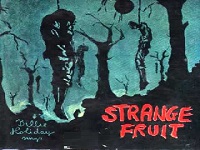
- Billie Holiday records "Strange Fruit"-a haunting vocal describing lynching. Disturbed by a photo of a lynching, Abel Meeropol, a Jewish schoolteacher and activist from the Bronx, writes this verse and melody under the pseudonym Lewis Allan. The song increases public recognition of lynching as racist terror. Between 1882 and1968, mobs lynched 4,743 persons in the United States, over lxx percent of them African Americans.
- 1946
- President Truman problems Executive Order 9808, establishing the President'due south Committee on Ceremonious Rights to propose measures to strengthen and protect the civil rights. Truman appoints to the Committee leading black civil rights activist, Sadie Alexander, the start black women to earn a PhD and an early on leader in the Philadelphia Urban League. Its report, To Secure These Rights, led to Truman'southward orders to end segregation in the U.S. war machine and federal Civil Service arrangement. Afterward in the 1960's President Johnson enlarges Truman'due south efforts with various civil rights and affirmative activity laws to address persistent discrimination.
- 1954
- Brown v. Board decision declares segregation in public schools illegal.
- 1955
- The Montgomery Motorcoach Cold-shoulder begins on December five after Rosa Parks is arrested for refusing to give up her seat to a white human on the omnibus. This boycott lasts 381 days and ends with the desegregation of the Montgomery, Alabama bus system on Dec 21, 1956. Every bit a pastor of a Baptist church in Montgomery, Martin Luther Male monarch, Jr. leads this blackness bus cold-shoulder and becomes a national hero.
- 1957
- The Southern Christian Leadership Conference establishes and adopts nonviolent mass action as its cornerstone strategy to gain civil rights and opportunities for blacks. Working initially in the South under the leadership of Martin Luther King, by the mid 1960's King enlarges the system'south focus to address racism in the North.
- 1959-1963
- Rex's Letter from Birmingham Jail inspires a growing national civil rights movement. In Birmingham, the goal is to end the system of segregation completely in every aspect of public life (stores, no separate bathrooms and drinking fountains, etc.) and in chore bigotry. This aforementioned twelvemonth, he delivers his I Take a Dream Spoken language on the Washington Mall, which becomes an enduring symbol of King's legacy and influence.
- In Birmingham, a white man is seen placing a box containing a bomb nether the steps of the 16th Street Baptist Church, a black congregation. The explosion kills iv blackness girls attending Sunday schoolhouse. Twenty-iii others people are also injured in the blast.
- 1964
- President Johnson announces the "Great Society" with "abundance and liberty for all", and declares a "State of war on Poverty." Congress authorizes the Ceremonious Rights Deed, the most far-reaching legislation in U.S. history to ensure the right to vote, guarantee access to public accommodations, and the withdrawal of federal funds to any program administered in a discriminatory way.
- Start this year, growing frustrations in black communities over urban decay and lack of opportunities erupts into a wave of race riots through U.S. cities, including Los Angeles, Newark (NJ) and Detroit Michigan. The years 1964 to 1971 run into more than than 750 riots, killing 228 people and injuring 12,741 others. Additionally, more than xv,000 carve up incidents of arson get out many black urban neighborhoods in ruins.
- 1965
- Voting Rights Deed is passed, authorizing direct federal intervention to enable blacks to vote.
- Malcolm 10 is assassinated past members of the Nation of Islam (Black Muslims) in New York City.
- 1967
- Robert C. Weaver is appointed Secretary of Housing and Urban Evolution. He is the start black to concord a Chiffonier position in U.South. history.
- Edward Brooke (Massachusetts Republican) becomes the first black to serve in the Senate since Reconstruction.
- 1968
- On April 4, 1968, James Earl Ray assassinates Martin Luther King, while he is standing on the balcony of the Lorraine Motel in Memphis, Tennessee. In outrage of the murder, many blacks accept to the streets in a massive wave of riots across the U.South.
- Congress authorizes the 1968 Civil Rights Act, providing federal enforcement provisions for discrimination in housing. The 1968 expanded on previous acts and prohibited discrimination concerning the auction, rental, and financing of housing based on race, religion, national origin, sex, (and as amended) handicap and family status. This law enabled housing opportunities for blacks beyond the "ghetto."
- 2008
- On November 4, 2008, Barack Obama is elected President of the U.s.a..
Library Visitor of Philadelphia

Library Company of Philadelphia
Library Company of Philadelphia
Library Company of Philadelphia
Library Company of Philadelphia
Guild Portrait Drove, Gratz Collection, HSP
Portrait of Robert Purvis by Gutekunst Studio, n.d.
Library Company of Philadelphia
Library Visitor of Philadelphia
Catto
Library Visitor of Philadelphia
Portrait of Octavius V. Catto, Harpers Weekly 1871
The copyright holder of this image is not knowm
This low-resolution image for editorial purposes is used under a Off-white Use claim
This timeline was prepared for NHD Philly, the regional National History Day program for Philadelphia, Pennsylvania. It is a collaboration of more than thirty history and community-based organizations in the Greater Philadelphia region. The participating partners represent some of the nigh significant history collections and programs in the United States, as well as the region's extensive community of education and heritage tourism enterprises. In add-on to the regional National History Twenty-four hours Competition, the collaboration provides programs and products that support not only learning history, but also the development of inquiry and analytical skills through the exploration of special collections, athenaeum, museums and historic sites.
lancasteryoughlythers.blogspot.com
Source: https://www.ushistory.org/more/timeline.htm
0 Response to "Clip Art Group Protesting New Jersey State Clip Art"
Post a Comment